Innovation Inc.
The Attention Economy's First Real Competitor Costs $187 and Fits in a Backpack

Jeff Rasch, Economic Integrity
In *Simulation Inc.*, we explored the software ending — what happens when the screen gets so good at building worlds that don’t exist that people stop leaving them. The feed perfected. The simulation seamless. Attention captured and sold at industrial scale. That was the path where software eats everything, including us.
This is the other path. The hardware path. The one that goes outside.
Elon Musk has been saying it for years, and he is right: software people are about to get a very hard lesson in hardware. Bits compile in milliseconds. Atoms push back. A rocket that is designed wrong does not throw an error — it explodes. A factory that is optimized wrong does not lag — it bleeds capital at a rate no deployment can fix. The physical world does not accept pull requests. It has its own laws, and they do not care about your release schedule. That is what makes hardware hard. It is also what makes hardware *valuable* — because when AI writes the software and everyone can build an app in an afternoon, software becomes a commodity. What becomes scarce is the thing that touches atoms. The sensor that reads a canyon wall. The instrument that tests a river. The tool that goes into the dirt and comes back with data that did not exist before. Hardware is hard. That is precisely why it is about to matter more than it has in fifty years.
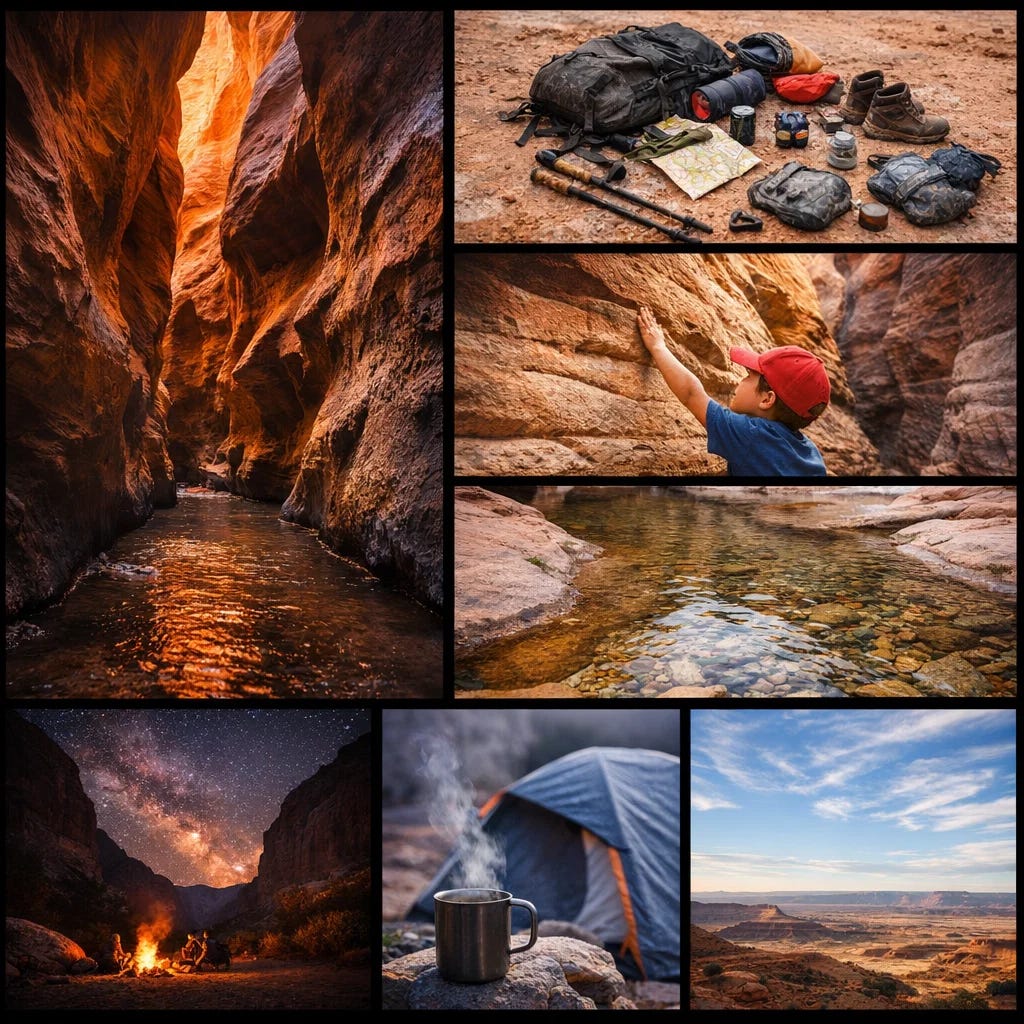
By 2030, the thing that finally breaks the attention economy will not be a law, a boycott, or a parental control setting. It will be a nine-year-old kid standing on a rock ledge in southern Utah holding a device that did not exist eighteen months ago, built by a woman in Boise he will never meet, looking at data about the canyon below him that no geologist has ever seen — and he will not think to check his phone for four straight hours. Neither will his dad. Neither will the two friends they brought. The cure for the screen will not be a lecture about the screen. It will be something so much better than the screen that the screen becomes boring.
This is the story of how that happens, what the device in his hand actually is, and why the industry that builds it will be larger than social media within a decade of its emergence.
---
### Part I: What Luke Is Carrying
Luke Adeyemi is eleven. His father Kola is forty-one. They are standing at the rim of a slot canyon fourteen miles east of Escalante, Utah, at 6:47 in the morning on the third Saturday in October 2030. The temperature is 38 degrees. The light hasn’t reached the canyon floor yet. Kola can see his breath. Luke cannot, because Luke is already climbing down.
This is not a day hike. They packed in last night — two miles along a bench trail to a flat above the canyon rim, headlamps on, packs heavy with sleeping bags and a camp stove and enough food for two days. The two friends — Mateo, age twelve, and Ayo, age ten — shared a tent. Luke and Kola shared the other. Kola was asleep by 8:30. Luke lasted until 9, which was a personal record for him on a trip. The stars had been too good.
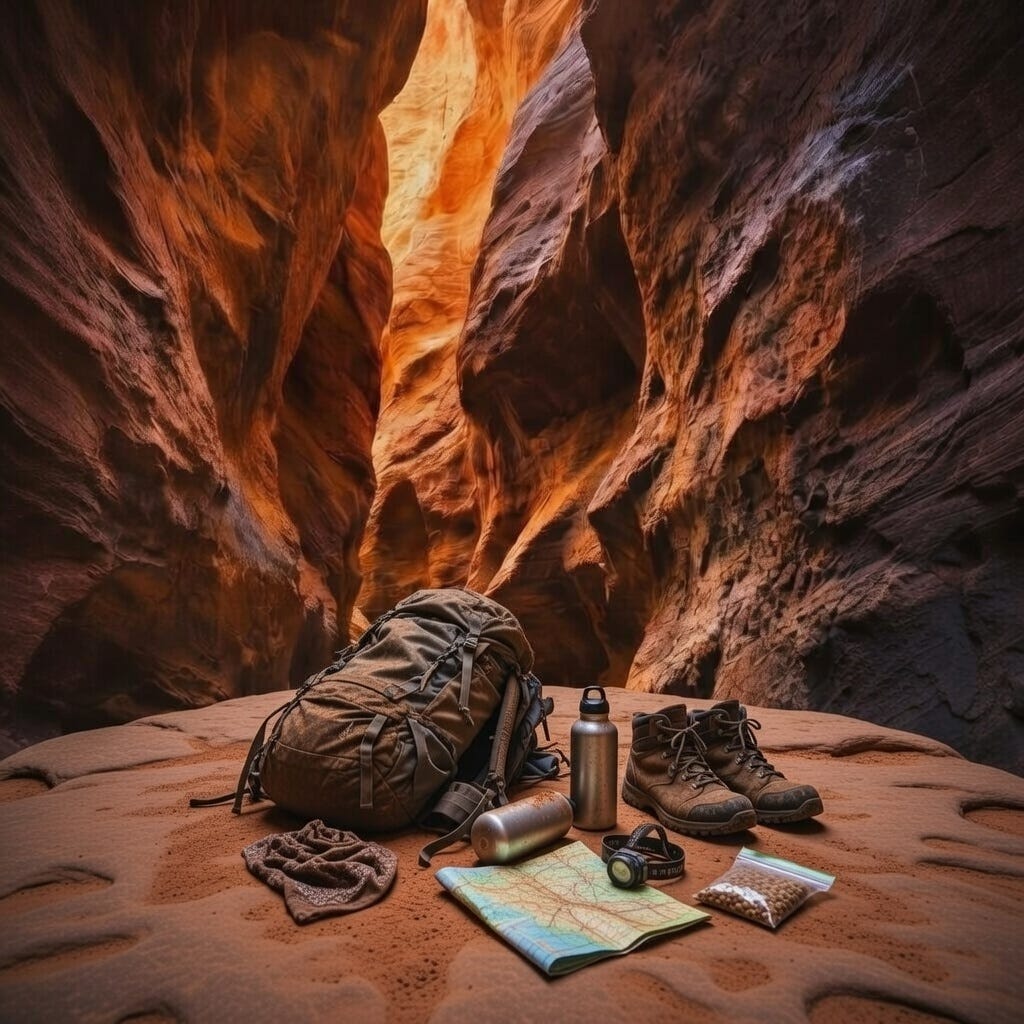
In Luke’s day pack — a 22-liter frameless bag his father bought used — there are seven items that would not have existed at any consumer price point in 2025.
A terrain sonar the size of a deck of cards. You point it at rock and it shows you what is behind the wall — hollow chambers, passages, fracture lines — on a small e-ink screen that runs for eleven days on a charge. The brain inside it is a $4 chip running a model trained on 1.6 million geological surveys published by the USGS over the last seventy-seven years. Everything the United States government has ever mapped underground, compressed into a device that fits in a chest pocket. It was designed by a 23-year-old geophysics student in Colorado who had never manufactured a hardware product before. She sent the design to a factory overseas, listed the finished device on an open-hardware marketplace for $31, and has sold 140,000 of them. Point it at a riverbed and it maps the depth contour of the pool. Point it at a canyon wall and it tells you if there is a cave behind the sandstone. Luke uses it for both.
A water chemistry pen. You dip it in any body of water and it reads five things instantly: acidity, dissolved oxygen, nitrogen levels, clarity, and temperature. What makes this pen possible is a collision between two worlds that had no reason to meet. A university in the Netherlands published an open-source design for a tiny chemical sensor — the kind that reads electrical signals too faint for normal electronics to detect. Separately, a company that makes hearing aids had spent years perfecting a chip designed to amplify the weakest whispers of a damaged inner ear. It turns out that amplifying a faint signal from inside a human cochlea and amplifying a faint signal from ions in river water is almost exactly the same engineering problem. A retired hydrologist in Nebraska knew both worlds — he had been wearing the hearing-aid chip in his left ear for six years and thinking about water sensors for thirty — and he saw the bridge. He built the pen for $8 in parts. Nobody at the hearing-aid company imagined this use. Nobody at the Dutch university knew the chip existed. One man who lived in both worlds did.
A mesh radio the size of a Zippo lighter. Turn it on and it finds every other unit within four miles. No cell towers. No subscription. No account. Everyone in your group appears on a shared topographic map stored locally on the device. Voice, text, location sharing — all of it working in a canyon where your phone is a paperweight. The protocol was designed by a ham radio operator in Alaska who had been running long-range communication experiments on mountaintops for a decade. The hardware was designed by a former Tesla firmware engineer who left because she wanted to build things that got people outside instead of things that kept them in cars. She combined the Alaskan’s protocol with a $3.40 radio chip from the drone supply chain and a GPS module, put it in a case her twelve-year-old son designed on a free program and printed in their garage. She sells the radio for $27. She has sold 900,000 of them.
A hand-crank atmospheric sensor. Temperature, pressure, humidity, wind speed, UV index. No battery. A five-second crank of a tiny handle — the same dynamo technology that has powered hand-crank flashlights since the 1940s — gives two hours of passive weather monitoring. The data logs to a memory card. The entire bill of materials costs $6.20. The design is open-source, which means anyone can build it. Fourteen different manufacturers do. The one in Luke’s pack was built by a cooperative of former meteorology students in the Philippines who started the project as a disaster-preparedness tool for communities that lose power during typhoons and realized it was equally useful for anyone who wants to understand what the sky is doing.
A satellite messenger that weighs four grams. Emergency beacon plus two-way texting, anywhere on Earth, using a constellation of satellites that has been orbiting since the 1990s. Satellite messengers are not new. What is new is the price. In 2025, this capability cost $350 plus a monthly subscription. By 2030, it costs $44 with no subscription, because the component that made it expensive — a proprietary communication chip — became available as an open design in 2028. The device works everywhere on the planet.
A pair of bone-conduction audio glasses. Not new either. What is new is what they run. The glasses have a small forward-facing camera and a low-power vision chip. When Luke looks at a rock face, they identify the layers and narrate them — not in the voice of a textbook, but in the voice of a curious person who finds it genuinely interesting:
“That red band is Wingate Sandstone. It was a sand dune 200 million years ago. The whole desert you’re standing in was a dune field the size of the Sahara. That dark line above it? That’s where the dunes stopped and an ocean came in. You’re looking at a beach that hasn’t existed for 190 million years.”
Point the glasses at a cottonwood tree and they tell you why its roots mean water is close. Point them at a bird and they identify the species by silhouette. Point them at the night sky and they map the constellations and tell you which planets are visible. The model was trained by a former park ranger who got tired of watching visitors walk through the most extraordinary landscape on Earth without seeing any of it. She built the audio guide in a week. The glasses cost $60. The software is free.
Luke’s total day-pack weight, including water, food, and all seven devices: 4.2 kilograms. The combined cost of every piece of technology in both packs that did not exist five years ago: $187.
---
### Part II: How These Things Got Built
Five years ago, none of those objects could have been prototyped by the people who built them.
The geophysics student did not know how to design a circuit board. The hydrologist in Nebraska had not written code since 1994. The Tesla engineer had never manufactured a consumer product. The park ranger had never trained an AI model. The Filipino cooperative had never sourced components from an international supply chain. The ham radio operator in Alaska had been sketching circuits on napkins for forty years and had never sent a design to a factory.
What changed was not their talent. What changed was the distance between their talent and a finished product.
Think of it like writing a book. In 1990, writing a book meant finding a publisher who believed in you, a printer who would set the type, a distributor who would put it on shelves, and a bookstore willing to give it space. The talent was necessary but nowhere near sufficient. By 2010, you could write a book on your laptop and sell it on Amazon by Thursday. The talent became sufficient. The distance between the idea and the reader collapsed.
The same collapse happened to physical products between 2025 and 2030. Except the distance that collapsed was not one barrier — it was five, and they fell in sequence.
The first barrier was design. In 2025, designing the electronic guts of a hardware product required either an engineering degree or years of self-taught skill with specialized software. A single mistake in the circuit layout could cost weeks and hundreds of dollars. By 2027, an AI assistant could take a rough sketch — literally a photograph of a drawing on a napkin — and produce a finished, manufacturable design in under an hour. Not a suggestion. A design ready to send to a factory, with a parts list, a simulation of expected performance, and a warning about the three things most likely to go wrong. The human still had to know what they wanted the thing to do. The machine handled how.
The second barrier was code. Every piece of hardware runs software — firmware, the instructions burned into the chip that tell it what to do. Writing firmware required fluency in programming languages designed for machines, not people. By 2028, you could describe what you wanted the device to do in plain English and get working code on the first try more than 80% of the time. The other 20% required a conversation, not a rewrite.
The third barrier was manufacturing. In 2025, getting circuit boards built meant navigating a supply chain that assumed you were ordering thousands. Minimum orders. Tooling fees. Months of waiting. By 2029, you could order five assembled boards for $22 with a four-day turnaround. It became cheaper to build a physical prototype and test it than to simulate one on a computer.
The fourth barrier was intelligence. Training an AI model on specialized knowledge — 380,000 geological field notes, or 1.6 million government surveys — once required a team of data scientists, expensive computing hardware, and weeks of iteration. By 2028, it could be done on a rented computer in a few hours for a few dollars. The model did not need to be built from scratch. It needed to be aimed. The human provided the knowledge. The machine provided the pattern recognition at a scale no human could match.
The fifth barrier was distribution. Getting a finished product to buyers once required capital, warehouses, and retail relationships. By 2029, three major open-hardware marketplaces had emerged — platforms where creators list products alongside their complete designs, and a global network of contract manufacturers bids on production runs. The creator never touches inventory. The buyer receives a product designed in a garage in Alaska and manufactured in a factory in Guangdong. Both parties are protected by a system neither had to build.
The result: a retired hydrologist in Nebraska with an idea about hearing-aid chips and water sensors could go from a napkin sketch to a product on a global marketplace in less than ninety days. He did not need funding. He did not need a team. He did not need permission. He needed the idea, the judgment to recognize it was good, and tools that had not existed three years earlier.
Those tools did not arrive in a single announcement. They accumulated. Design assistance in 2026. Code generation through 2027 and 2028. Manufacturing costs crossing the threshold in 2027. The marketplaces consolidating in 2028 and 2029. Each step was incremental. The compound effect was not.
By 2030, the number of individuals worldwide who had shipped at least one original hardware product exceeded 6 million. In 2024, the number was approximately 40,000.
---
### Part III: What Happens When Six Million People Build Things
The first effect is obvious: there are more products. More tools, more sensors, more devices solving more problems in more niches than any corporation could serve. Luke’s terrain sonar exists because a geophysics student cared about a problem too small for Garmin and too physical for a software startup. The water chemistry pen exists because a man who spent his life thinking about water happened to also spend six years wearing a hearing-aid chip and one day noticed the overlap. The mesh radio exists because a ham operator and a firmware engineer found each other on a forum and discovered their skills were complementary.
Six million creators producing for niches that no centralized company would address. Long-tail hardware. The equivalent of what blogs did to publishing and podcasts did to radio, except the output is physical objects that interact with the physical world.
The second effect is less obvious and more important: the people who build these things are not looking at their phones.
This sounds trivial. It is not.
The average American adult in 2025 spent four hours and thirty-seven minutes per day on their smartphone. The architecture of that attention was not accidental. It was engineered. The infinite scroll, the unpredictable rhythm of notifications, the feed tuned to maximize time spent — these are the same behavioral feedback loops that drive slot machine design, applied to a device that lives in your pocket and knows your patterns of vulnerability. The business model of the attention economy is the monetization of captured human time. The product is not the app. The product is you, sold by the millisecond to the highest bidder.
Seven hundred billion dollars in global digital advertising revenue in 2025 depended on the continued capture of that time. Every hour a human spent creating instead of consuming was an hour the advertising industry could not sell.
The creation economy did not set out to destroy the attention economy. It had no manifesto. What it had was a simple arithmetic: making something is more absorbing than watching something.
Psychologists have a name for the state where you are so immersed in a task that you lose track of time and feel deep satisfaction afterward: flow. Flow is triggered by activities that balance challenge and skill. Scrolling is too easy to trigger it. Creation triggers it reliably. Designing a circuit, writing firmware, testing a prototype, iterating on a failure, shipping a product — these engage the brain at a level that social media structurally cannot reach.
The six million creators were not boycotting their phones. They were too busy to pick them up.
Their children noticed.
---
### Part IV: The Canyon
Luke is forty feet below the rim. His father is twenty feet above him. Mateo and Ayo are on a parallel route that Kola plotted on the topographic map last night using the barometric pressure readings from the atmospheric sensor, which told him the inversion layer would keep the canyon floor cold until at least 9 AM, which meant the sandstone would still be grippy and dry on the east-facing walls where the boys would be climbing.
Luke pulls the terrain sonar from his chest pocket and fires a chirp at the wall in front of him. The e-ink screen refreshes. The cross-section shows a void — a hollow chamber behind the rock face, roughly ten feet wide and fifteen feet deep, with what appears to be a secondary passage angling downward. Luke does not know what caused the void. The audio glasses tell him: “Alcove formation. Water carved this when the canyon was a river. The passage behind it probably connects to the drainage below. The rock around the void is weaker than the wall above it. Don’t pull on the overhang.”
Luke marks the location on his mesh radio and sends a note to the other three units. Kola’s radio chirps. He sees Luke’s position, the message — “cave behind wall, big, passage goes down” — and the structural warning from the audio guide. He does not shout. He texts back on the mesh: “Cool. Don’t go in without me.”
An hour later, all four of them are inside the alcove. It is ten degrees cooler. The ceiling is smooth from centuries of water. Kola runs his hand along it and does not say anything for a while. The audio glasses tell Ayo that the dark mineral stain on the back wall is desert varnish — manganese oxide deposited by bacteria over thousands of years. Ayo touches it. He is touching something that took longer to form than human civilization has existed. He does not know this in those words. He knows the rock feels different and the glasses say it is very old.
They keep moving down.
---
### Part V: The Creek
By noon they reach the bottom.
The drainage floor is sand and smooth stone and a creek that appears from nowhere — seeping out of the canyon wall on the east side, running thirty feet across the flat, and disappearing into a crack in the west wall. The water is clear and cold and six inches deep.
Mateo is the one who pulls out the water chemistry pen first. He has been waiting for this since the trailhead. He dips the pen. The readings come up: dissolved oxygen is high — the water is tumbling over rock and picking up air. Nitrogen is elevated — four times the background level, which means something upstream is leaching fertilizer into the drainage, probably runoff from the ranch land on the plateau above. Acidity is slightly alkaline, consistent with water that has been filtering through limestone. Temperature: 48 degrees Fahrenheit. Cold enough that anything living in it is adapted to cold.
Mateo logs the reading. It will join 11 million other field measurements uploaded by sensor users to a distributed environmental monitoring network that no government funded and no corporation built. Hydrologists at three universities are already publishing papers from this dataset. The EPA cited it in a 2029 rulemaking for the first time. The data is collected by children and hobbyists and retired scientists and people who just wanted to understand the water they were standing in.
But Mateo is not thinking about the EPA. He is thinking about the dissolved oxygen number, because his dad taught him that high dissolved oxygen in cold water means the conditions are right for fish. He starts looking at the pools.
Kola walks upstream to where the water emerges from the wall. He holds the terrain sonar against the rock and fires a chirp. The screen shows the water source — an underground channel running roughly northeast, fed by what appears to be a fracture network in the Navajo Sandstone above. The canyon’s creek is not surface water. It is rain that fell on the plateau, percolated through hundreds of feet of rock, and is now arriving here — filtered, cold, and clean except for whatever the ranches above have been feeding the soil.
Luke and Ayo follow the creek downstream to where it widens into a pool about three feet deep before vanishing into the western wall. Luke holds the terrain sonar over the pool and maps the bottom. The depth profile shows a shelf of sandstone, a drop to a deeper channel, and a cluster of rocks on the far side that create a slow eddy where the current stalls.
Kola has taught Luke what a holding spot looks like. Still water behind structure, adjacent to current. Food drifts into the slow zone and the fish wait there instead of fighting the flow. Luke did not learn this from a video. He learned it standing in the Escalante River two years ago with Kola’s hand on his shoulder, watching where the line went.
Ayo finds the fish. Not in the pool but in the side channel — a narrow run between two slabs of Kayenta sandstone where the water is only four inches deep but moving fast. Three of them, holding in a line, each one tucked behind a slight bump in the rock that breaks the current just enough. They are small — six inches, maybe seven. The audio glasses identify them as speckled dace, a native minnow common in cold desert streams throughout the Colorado Plateau. Ayo did not know desert canyons had fish. He did not know this creek existed until an hour ago. He lies flat on the sandstone with his chin on his hands and watches them hold their position in the current, adjusting with a flick so small he can barely see it, for ten minutes. He is ten years old and he has never watched anything this closely in his life.
They will not catch the dace. They are too small and the creek is too fragile. But Kola has a telescoping rod in his pack and a handful of small flies in a tin that weighs less than a deck of cards, and there is a deeper pool downstream where the drainage meets a side channel and the water slows and deepens to waist height. They will fish that pool for an hour in the late afternoon. Kola will catch two and release both. Luke will lose one at the bank and spend five minutes sitting on a rock saying nothing about it, which is how Kola knows it mattered. Mateo will not catch anything but will test the water in every pool they pass and build a chemical profile of the entire drainage from seep to sink, because that is the thing that lights him up.
---
### Part VI: The Camp
They make camp on the flat above the canyon rim at 5 PM. Same spot as the night before. The atmospheric sensor says the barometric pressure has been dropping since noon — a front is moving through. Kola cranks it and reads the humidity. Rising. Temperature falling faster than it should for this time of day. The model on his phone — which still has no signal but runs the weather algorithm locally — says a 40% chance of rain after midnight. He rigs the tent flies lower and tighter than last night and shows Luke how to trench the uphill side with the heel of his boot. Not deep. Just enough to redirect the sheet flow if it comes.
Mateo builds the fire. He has done this before. Kola does not correct him. He watches and waits. Mateo starts with a bundle of juniper bark shavings — stripped from a dead branch, not a living tree, because Kola taught him the difference two trips ago and does not need to teach him again. He builds the tinder nest, lights it with a ferro rod, feeds it with pencil-thin sticks of dead sagebrush, and has a stable flame in three minutes. Kola nods once. That is the whole review.
The camp stove is for boiling water. The fire is for everything else. They heat soup. They eat trail mix and jerky and the dried mango that Ayo has been rationing since yesterday. They pass a water bottle. The sky goes from blue to orange to deep violet, and then the stars come in.
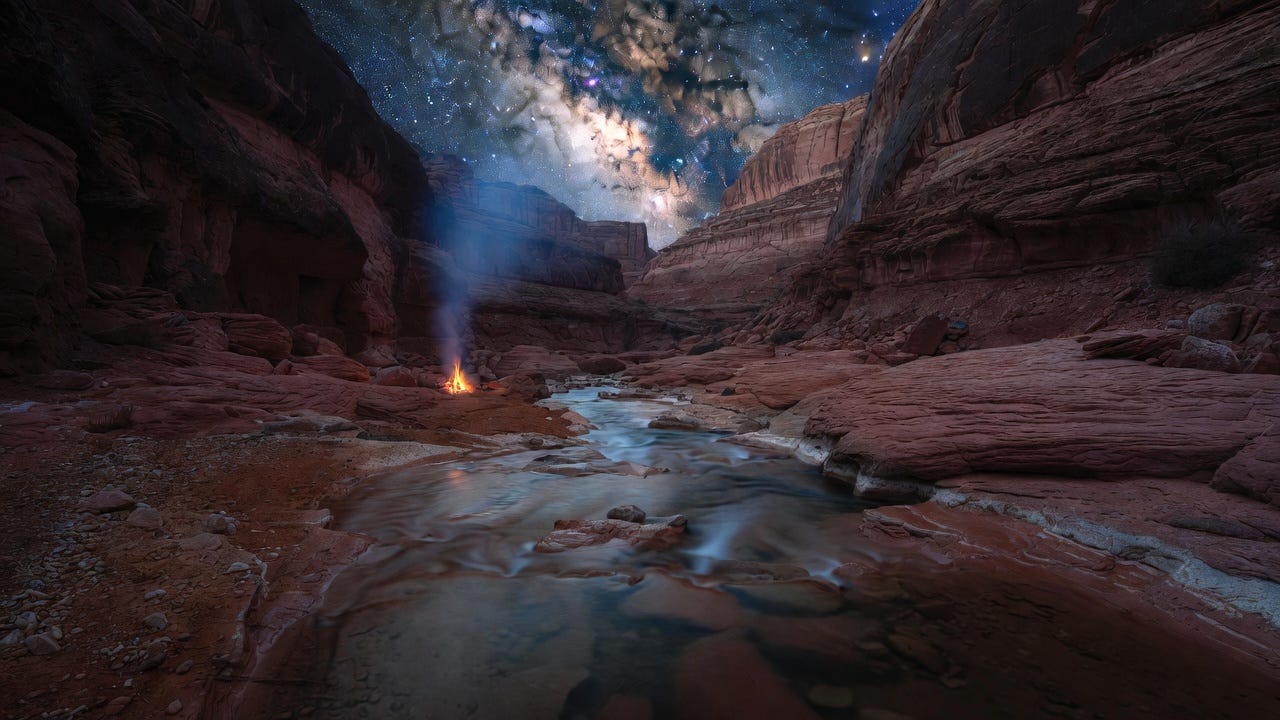
There is no light pollution in this part of Utah. None. The Milky Way does not appear gradually. It arrives like a door opening. Ayo puts on the audio glasses and looks up. The glasses map the constellations in real time — tracing the lines, naming the stars, identifying Jupiter hanging bright and steady above the western rim. “That’s Jupiter,” the glasses say. “It’s 450 million miles away right now. The light you’re seeing left there 35 minutes ago.” Ayo takes the glasses off and looks at Jupiter with his own eyes, knowing what he is looking at for the first time in his life. The glasses did not replace the experience. They unlocked it.
Luke is lying on his back on the sandstone next to the fire. His mesh radio is clipped to his chest strap. His terrain sonar is in his pocket. His audio glasses are on his forehead, pushed up. He is not using any of them. He is looking at the sky with his father sitting three feet away and his two best friends arguing about whether the streak they just saw was a meteor or a satellite.
Kola has not touched his phone in thirty-one hours. It is in his truck, twelve miles away, turned off. He does not miss it. He has not thought about it once.
The fire pops. Ayo says the streak was definitely a meteor. Mateo says it was too slow. Luke says nothing because he is almost asleep, and the last thing he sees before he closes his eyes is the band of the Milky Way directly above him, and he does not think about how many people are looking at it, or how it got there, or what it means. He thinks it looks like a river.
---
### Part VII: The Morning
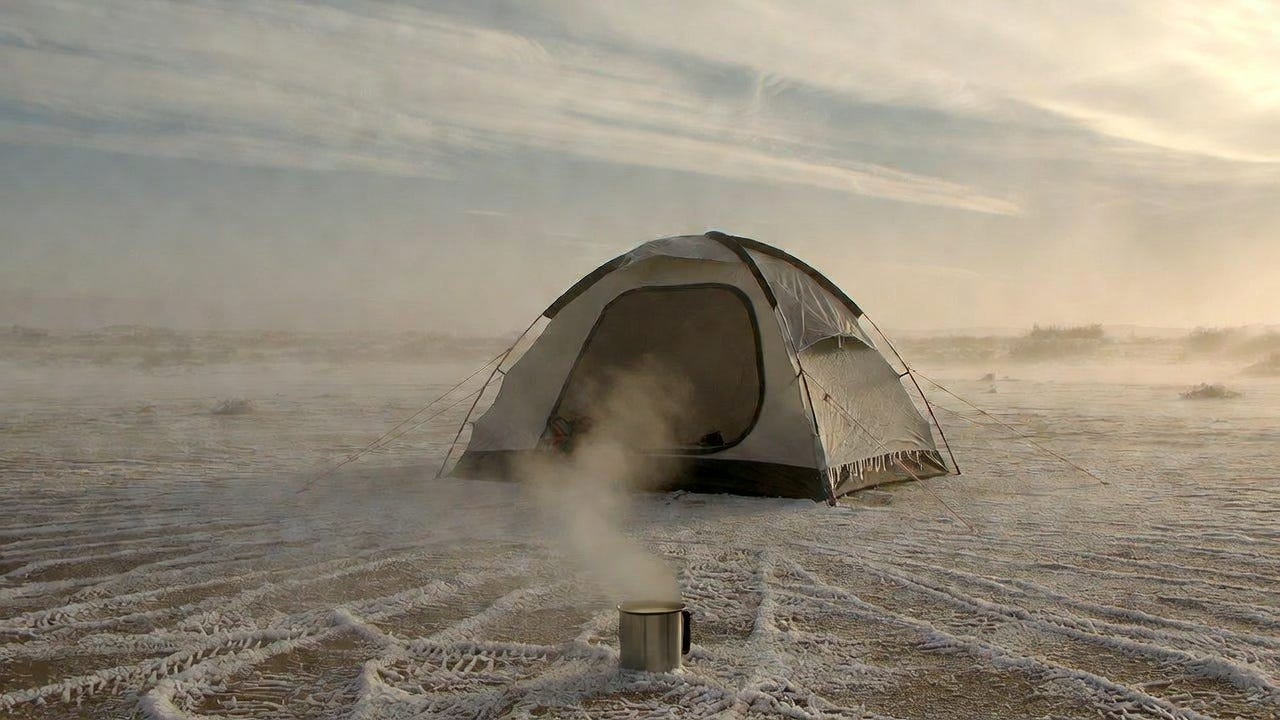
Dawn. 6:12 AM. The front came through but the rain stayed north. The air is colder than yesterday — 34 degrees. Frost on the tent flies. Kola is already up, crouched by last night’s fire pit, pulling the coals apart. He banked the fire before bed — pushed the unburned ends of the logs together, covered them with ash — and now there are still live coals underneath. He feeds them small sticks. Flame in forty seconds. He does not use a lighter. He does not need to.
Luke crawls out of the tent and sits next to the fire without speaking. Kola hands him a cup of instant coffee with too much sugar in it. This is a trip tradition. At home Luke does not drink coffee. On the canyon rim at 6 AM in October, he drinks coffee. Kola does not explain why this is allowed. It is allowed because they are here and not there, and the rules are different when the ground is cold and you slept on it.
Ayo finds the fossil at 7:15 AM. They are breaking camp, rolling sleeping bags, stuffing packs. He is pulling a tent stake from the sandstone edge when he sees it — embedded in the Kayenta Formation, right at the surface, half-exposed by wind erosion. A curved shape. Textured. Not rock. The audio glasses narrow it to three candidates and suggest that a photograph submitted to a paleontology forum would likely get a definitive answer.
Ayo will submit the photograph that evening from the motel in Escalante. A graduate student at the University of Utah will respond in four hours: a temnospondyl skull fragment. An ancient amphibian that lived here before the dinosaurs, when this desert was a floodplain and the air was heavy and warm and the animals that breathed it were nothing like anything alive today.
Ayo is ten years old. He has just contributed to the geological record of the Kayenta Formation. He does not know this. He knows he found a skull while pulling up a tent stake, and that it has been waiting in the rock for longer than he can hold in his mind.
They hike out by 9 AM. Twelve miles to the truck. Luke leads. Kola watches from behind. The mesh radios chirp their positions to each other every thirty seconds — four dots moving together along a bench trail above a canyon that, as of yesterday, has its first subsurface survey, its first complete water chemistry profile from seep to sink, and a new entry in the fossil record.
None of them set out to do science. They set out to spend a weekend in the dirt. The science happened because the tools made it effortless, because the data infrastructure made contribution automatic, and because the physical world — the actual, dirt-and-rock, sun-and-cold, 200-million-year-old physical world — is the most data-rich environment on the planet and almost none of it has been measured at the resolution that six million people carrying sensors can achieve.
---
### Part VIII: The Arithmetic of the Shift
There are 73 million children under the age of 18 in the United States. There are 258 million adults. Collectively, they represent approximately 1.4 billion hours of smartphone screen time per day. At the rates the advertising industry charges for mobile attention, that time is worth roughly $2.2 trillion per year.
The creation economy does not need to capture all of that time to break the model. It needs to capture enough of it to bend the curve.
In 2028, the first year the open-hardware exchanges published user data, the average active creator on the platform spent 6.2 fewer hours per week on social media than the national average. The survey was self-reported and imperfect. But the magnitude was consistent across age groups, income brackets, and geographies, and it replicated every quarter afterward. The creators were not anti-technology. They were using more technology than ever. They were using it to make things instead of consume things.
By 2030, the creation economy — the total economic activity generated by individuals using AI-assisted tools to design, prototype, manufacture, and sell original hardware products — was valued at approximately $340 billion globally. For context: the global fitness industry in 2025 was worth $96 billion. The global video game industry was worth $184 billion. The creation economy, five years into its exponential phase, was already larger than both combined.
But the number that mattered most was not revenue. It was time.
By 2030, an estimated 340 million people worldwide had spent at least one hour in the previous month building, testing, or deploying a physical creation-economy product. Three hundred and forty million people who, for at least that hour, were not scrolling. Were not watching. Were not being sold to. Were making something with their hands and their minds and — in a surprising number of cases — with the person next to them.
The attention economy did not collapse. It contracted. Global digital advertising revenue in 2030 was $688 billion — down from $740 billion in 2028. The first decline in the history of the industry. The cause was not regulation. It was not a recession. It was that a measurable fraction of the human population had found something better to do.
The industry called it “the engagement gap.” Internal documents from two of the five largest social media companies — leaked in October 2030 — described the problem in terms worth reading exactly: “Users who adopt creation-economy tools show a mean reduction in daily platform engagement of 38 minutes within the first 90 days of active creation. This reduction is persistent, does not recover after the initial creation project is completed, and compounds with each subsequent project. The users are not churning. They are reducing. They are spending their time on something we cannot compete with because the something is not a platform. It is an activity.”
---
### Part IX: Why It Is Not a Screen
The most important fact about the creation economy is what it produces.
It does not produce content. Content is a digital artifact designed to be consumed through a screen. The creation economy produces objects. Physical objects that exist in three dimensions, that interact with the real world, that can be held and used and broken and repaired. A terrain sonar. A water chemistry pen. A mesh radio. An atmospheric sensor. Audio glasses that narrate geology and map constellations and identify the fish holding in the current.
The objects go outside. They go into canyons and rivers and forests and oceans and fields and mountains. They go where the screens cannot follow — not because the screens are prohibited, but because the objects make the physical world more interesting than the screen.
This distinction matters because the loneliness epidemic is not caused by technology. It is caused by the specific kind of technology that replaces shared physical experience with solitary digital consumption. The automobile killed the front porch. The television killed the parlor. The smartphone killed the last remaining interstitial moments — the elevator, the checkout line, the waiting room — where strangers might accidentally become acquainted. Each displacement moved human interaction from physical presence to mediated distance.
The creation economy reverses the direction. Not by removing technology. By redirecting it. The mesh radio does not replace conversation. It enables conversation in places where phones do not work. The terrain sonar does not replace the hike. It makes the hike richer. The audio glasses do not replace the experience of standing in front of a 200-million-year-old beach preserved in stone. They make the experience legible. Every object in Luke’s pack is designed to enhance physical presence, not replace it.
And the building of those objects is itself a physical, social act. The firmware engineer and the ham operator met in person after three months of remote collaboration. They now meet every Saturday to test prototypes on ridgelines above the Gastineau Channel in Alaska. The geophysics student runs a monthly meetup in Golden, Colorado, where other student-creators bring their hardware and test it on the geology they can see from the parking lot. The Filipino cooperative has a workshop in Cebu City where they assemble, test, and ship from a single room. The retired hydrologist in Nebraska invited the hearing-aid electrode designer from the Netherlands to visit. He came. They spent four days testing water sensors in the Platte River. They are now co-designing a sensor for oceanic microplastic detection. They had never been in the same room before.
Creation reconnects people because it gives them a reason to be in the same room. Not a feed. Not a notification. A reason. A thing they are building together that does not work yet and needs both of them to figure out why.
This is the social architecture that the attention economy structurally cannot produce. The attention economy requires isolation — a single user, a single screen, a single feed, a single data profile. The creation economy rewards collaboration — two people with different skills, different domains, different origin stories, discovering that the distance between their worlds is exactly the space where something new can exist.
---
### Part X: The Terrain We Are Training For
There is an eleven-year-old standing in a creek in a slot canyon in Utah with a terrain sonar in his pocket and a water chemistry profile on his pen and a fossil his friend found while pulling up a tent stake. He has spent two days learning — without curriculum, without a textbook, without a standardized test — how to read terrain. How to sense water chemistry. How to navigate without a cell signal. How to assess risk in a rock face. How to build a fire and bank it and bring it back. How to find fish in water he didn’t know existed. How to contribute data to a scientific record. How to travel through a landscape that was not built for him and understand what it is telling him.
He is learning how to explore a world that is trying to kill him gently and reward him immensely for paying attention to it.
This is not recreational. This is not extracurricular. This is the skill set of a species that is fourteen years away from putting human beings on the surface of another planet.
Mars has canyons. Valles Marineris is ten times the length of the Grand Canyon and four times its depth. Mars has terrain that no satellite has mapped at the resolution a human on the ground would need. Mars has geology that tells a 4-billion-year story we have only read the chapter headings of. Mars has no cell towers, no GPS calibrated for its surface, no rescue infrastructure, no hospital, no road. Mars has an atmosphere so thin that a 100-kilometer-per-hour wind barely pushes against your suit because there is almost nothing there to push with.
The people who go to Mars will not be the people who spent their twenties optimizing ad click-through rates. They will not be the people who built dashboards to justify dashboards. They will be the people who spent their childhoods in canyons and on ridgelines and in rivers with instruments in their hands and questions in their heads — who learned to read terrain the way you read a sentence, who learned to trust their instruments and doubt their assumptions, who learned that the physical world is not a backdrop for a screen but the most complex, dangerous, beautiful, and information-dense environment a human being can inhabit.
The creation economy is not training astronauts. It is training a generation of people who are not afraid of the physical world. Who find it more interesting than the digital one. Who have the tools to understand it and the confidence to move through it and the habit — the deep, practiced, compounding habit — of building the thing they need when it does not exist yet.
Luke does not know any of this. He is eleven. He found a cave and mapped a creek and watched his dad catch fish and slept on sandstone under the Milky Way and saw Jupiter and drank coffee at sunrise and hiked twelve miles out with a skull in the fossil record and his best friends on the trail ahead of him.
He is not thinking about Mars. He is thinking about the next trip. Whether the passage behind the wall goes all the way down. Whether Kola will let them camp inside the canyon next time, by the creek, where the water comes out of the rock and the fish hold behind the stones and the stars are framed by the walls on both sides.
That is enough. That is exactly the kind of person who ends up on Mars. Not the person who planned to go. The person who could not stop exploring where they already were.
---
### Part XI: The Ledger
The attention economy extracted $2.2 trillion a year by capturing time. The creation economy generates value by releasing it — returning human hours to activities that produce knowledge, skill, physical health, social connection, and objects that make the next exploration richer than the last.
Luke’s weekend in the canyon produced the first subsurface survey of that drainage ever recorded. A complete water chemistry profile from seep to sink. A new fossil identification in the Kayenta Formation. Seven atmospheric readings that will sharpen a crowd-sourced weather model used by hikers and ranchers across the Escalante region. Four human beings who spent thirty-one hours together without a single notification, without a single ad impression, without a single algorithmic intervention in their attention. A ten-year-old who learned what dissolved oxygen means by watching fish hold in a current. An eleven-year-old who learned to read the inside of a canyon wall the way his father reads weather — not by studying it, but by standing in it until it started to make sense.
The creation economy is young. It is growing faster than anyone expected, and there are hard questions ahead about where it goes and how it is governed. Those questions matter and they will get serious treatment.
But this piece is not about the questions. It is about the canyon.
The canyon has been here for 200 million years. It will be here when the servers go dark. The question is whether the people walking through it will know what they are looking at, and whether they will be looking at it together.
A father and three boys hiked out of a slot canyon in southern Utah on a Sunday morning in October with dirt on their knees and data in their pockets and a feeling in their chests that none of them will name but all of them will remember. The feeling of having been somewhere real. Of having paid attention to it. Of having understood — even a little, even imperfectly — what it was telling them.
The mesh radio chirps one last time as they reach the truck. Four dots converging on the map. Kola turns his off. Luke does not. He clips it to the dashboard and watches the screen until the battery-save mode dims it, because he likes seeing where they were.
The drive home is quiet. Ayo sleeps. Mateo reads his water chemistry log on the pen’s tiny screen, scrolling through the readings pool by pool. Luke sits behind his father and watches the desert go by through the window — red rock and juniper and sky so big it looks like it was drawn by someone who had never been told a sky should stop.
Kola drives. He does not turn on the radio. The silence is not empty. It is full of the canyon. It will take days to drain out, and by then they will already be planning the next one.
---
*The devices described in this article are projections based on technologies that exist in laboratories, early-stage companies, and maker communities as of February 2026. The cost trajectories, manufacturing timelines, and adoption estimates are extrapolated from current trends in open-source hardware, AI-assisted design, and distributed manufacturing. The canyon is real. The people are composites. The fossil is a guess. The future is not.*
---
*Economic Integrity LLC*
*[footballstool.com](https://footballstool.com) · [innovationbible.com](https://innovationbible.com) · [economicintegrity.substack.com](https://economicintegrity.substack.com)*
*Ship fast. Learn faster. Combine everything. Give generously.*
This made me put my phone down for a second. The idea that the real world can become more addictive than the feed because you’re building, testing, exploring, feels like the right kind of future. I’m watching this one closely.